Solutions to the Nation-State Regime: Guiding Principles
Published : June 24, 2023
It is easy to highlight the problems of the nation-state regime, so now let us move to the challenge of building a better government. Before solutions are proposed, we must discuss a few guiding principles to help focus the effort.
It’s Time to Separate Racial-ethnicity and State
Human beings can be classified or grouped in a variety of ways. Some of the most common groupings are listed below:

The boxes highlighted in pink are the key communities that form the nation-state. Religion, while still dominant in some nation-states, has been formally separated from the state in much of the world. There are, however, exceptions to race/ethnicity and geographic location as being the two foundational communities. For example, most nation-states allow immigration, which mixes people from different races and ethnicities into one nation-state. Additionally, some nation-states have administrative authority over satellite locations far from home soil (e.g. the British Virgin Islands approximately 6,000 km from London; Hawaii as a part of America). But in general, a human being’s conception of “where they belong” from an administrative perspective is generally rooted in these two categories.
It is rational for geographic location to form an administrative community as many state functions require people to be in close proximity. These include child education, ensuring water and air quality, and management of public recreation areas, roads, infrastructure, etc. All of these components of a civilization work best when people are close together.
However, a racial-ethnic community as a requirement for an administrative community is much less obvious. What is the rationale for one “German” pooling their tax resources with mostly other “Germans”? Does this produce better administrative outcomes? Would spending programs to feed the hungry be any less effective if a “German” pooled their resources with someone who is “Chinese?” Does a public pension system provide better income security when two “Brazilian’s” pay into the tax pot vs. a “Brazilian” and a “Chilean”? The answer to both of these questions is no, racial-ethnicity makes no difference.
Furthermore, nationalist identities rooted in racial-ethnic tradition are largely inventions of enterprising politicians. So if we are receiving no benefit by organizing ourselves by racial-ethnicity while simultaneously incurring dangerous byproducts (e.g. racial-ethnic hostility and state sponsored racism), why do we continue to do so?
This phenomenon is largely rooted in tradition, and derived from a world where survival depended upon tribal allegiance. Nation is rooted in tribe, and it’s time to retire the tribes. #RetireTheTribes
Sources: Key facts about government-favored religion around the world | https://www.pewresearch.org/fact-tank/2017/10/03/key-facts-about-government-favored-religion-around-the-world/
National Identity Is Made Up|https://www.nytimes.com/2018/02/28/world/national-identity-myth.html
Published : June 24, 2023
Choice of Administrative Region Should be Easier
Membership to a nation-state is not a choice, it is assigned at birth. Changing one’s state requires years of administrative processing and substantial resources. Additionally, many risk their lives to cross “international” borders due to the dire environment of the nation-state of which they are born. These “illegal” crossings are merely human beings attempting to create a better life for themselves due to the false walls of the current nation-state regime.
Choice of Administrative Region is a natural right and the ability to change should not be a substantial effort. The ability to align one’s resources (in the form of tax) in exchange for a variety of services and governance must be easier in the new paradigm.
Published : June 24, 2023
Fixing Government is a Good Return on Investment
Government is one of the most crucial social systems to organize our daily lives. Allocating time to make government more efficient yields a significant return on investment. Approximately 20% of an individual earnings will be routed to government in the form of tax, as the effective average global tax rate is approximately 20%. Stated differently, with global GDP at approximately $100 trillion, $20 trillion of that goes to the government, or 2 hours of a 10-hour work-day are to produce money to send to the government. Making this spending as efficient as possible is crucial.
Sources: OECD.Stat|https://stats.oecd.org/index.aspx?DataSetCode=Table_I6
Published : June 24, 2023
Revolutions are not Complete Resets
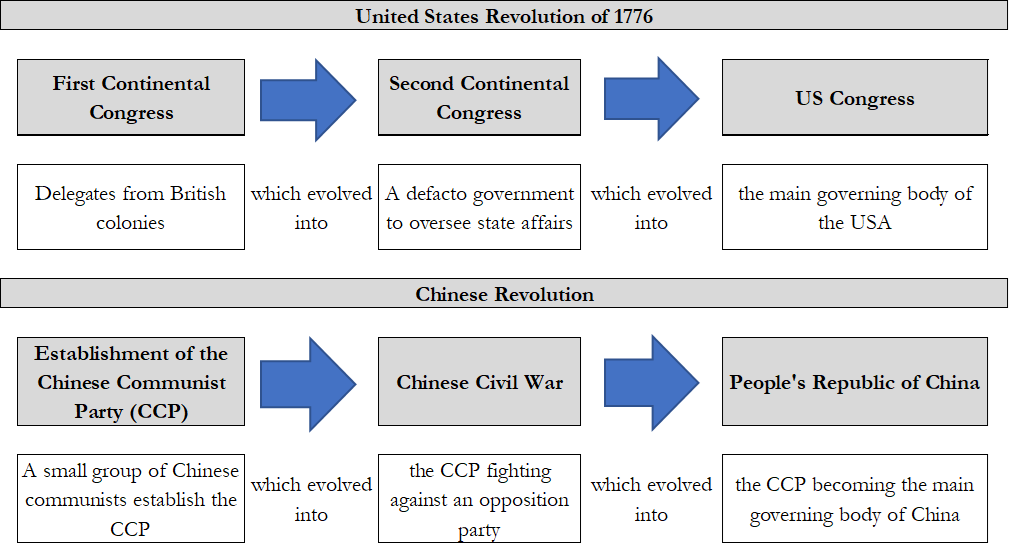
Political revolutions are never a complete “reset” in that there are pieces of the old system that grow into the new. Social structures have inertia, as elements of the prior structure transfer their energy into the new power regime. These familiar elements mitigate some of the volatility of transitioning to a new system. Stated differently, most revolutions are not a complete reset but more of a partial recalibration.
It must be noted that many of the political paradigm shifts in history have relied upon existing administration systems to facilitate the transition to the next power regime. Two examples of this phenomenon are illustrated below:
Published : June 24, 2023
Public Services and Regulation Should be Managed Separately
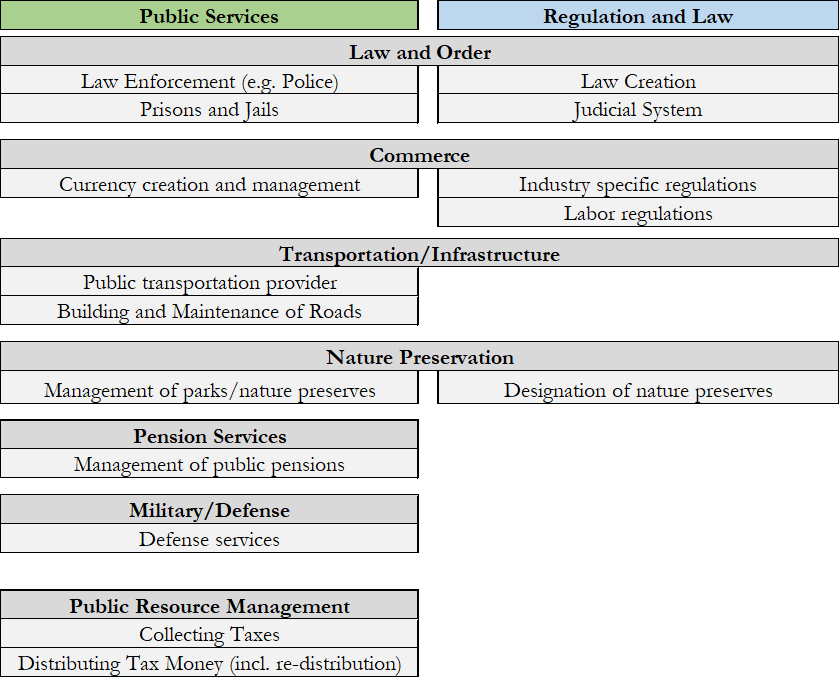
Nation-state governments under the nation-state regime lack focus. The current operating model of most national governments is a conglomerate of various public services and regulatory bodies. This merging of distinct functions creates a lack of common goals and exacerbates the frictions of bureaucracy. Government leaders are expected to provide public services and goods while simultaneously participating in the creation and enforcement of regulation and law. This broad mandate makes effective leadership difficult.
In the private sector, conglomerates that attempt to offer disparate goods and services often
fail as employees and management are unable to focus on the sale of core products and services. The market provides a natural check on these over-stretched firms as sales begin to decrease in non-core offerings, and management is pressured by shareholders to exit the business.
As this natural market check is not present in the public sector, administrative bodies should be simplified by splitting the delivery of public services and regulation. This split will drive better public services and more effective regulation.
Published : June 24, 2023
Strive For Better
Finally, it is easy to forget the exhaustive trial and error and millions of thought hours that have gone into refining the nation-state regime. While we must acknowledge the success and prosperity that the nation-state regime has brought, it is not an excuse for complacency; we must not assume that we have developed the best system. The status quo can always be improved, and we must strive to evolve socially. Change is always needed, and it is needed now.
Administrative Regions
Published : June 24, 2023
The repair work needed to fix the current governmental systems of humanity is plentiful, but in the context of the achievements of humanity, it is a very achievable goal. This text proposes a solution to replace the nation-state regime with the Administrative Region (AR), as well as alternate forms of government that should be explored, studied and debated.
Imagine a world of Administrative Regions
Imagine a world where existing international borders have been erased, and only the history books show the map we know today. The minds of those of the Administrative Region world will look upon the map of nation-states and ponder life of a different era.
The Administrative Region is a decentralized solution for the Nation-state regime, where a much smaller administrative body serves as the primary government. This system contrasts with the behemoth nation-state governments that rule the globe today. Administrative regions exist in their nascent form today as local governments. Whether it be city, country, township, state, or other; one would consider their administrative alignment to a region vs. a nation-state.
For example, people would be from “New York City AR” or “Shanghai AR” and would know people from “Berlin AR” or “Bogota AR.” Some Administrative Regions would form in less urban areas like Cape Cod AR, Inner Mongolia AR or Northern Bavaria AR.
The world without nation-states will give way to robust human innovation, at a pace of technological development that makes the present seem slow. Resources will be far more efficiently allocated and governments will no longer stall the growth of humanity. Instead, they will act as an instrument to accelerate it.
Published : June 24, 2023
The Most Pragmatic Solution
The Administrative Region (AR) is the most pragmatic solution to end the nation-state regime for several reasons, namely:
The AR solves many problems of the nation-state regime, including:
- The AR is not a new concept. National governments are the dominant administrator at the present, but regional/municipal/civic governments exist and thrive today and did in the past.
- Many government services are already performed and administered at the Administrative Region level (e.g. sanitation, education).
- Tax infrastructure, the collection and spending of tax money, is already established in many cities and regions globally. Tax money which is currently routed to federal governments could be diverted to local governments.
- Cities, which would serve as the epicenter of most ARs, contain ethnically diverse inhabitant pools that help increase empathy toward various ethnic groups, thereby reducing ethnic hostility.
- Many people feel an affinity toward the city they live in. It is a natural bond, a love for the soil where one’s feet meets the earth.
The visual below illustrates the nation-state flow of power as well as how that would differ under an Administrative Region world. Note the addition of a Regional Regulatory Consortium (RRC) which is discussed in greater detail below.
Before…
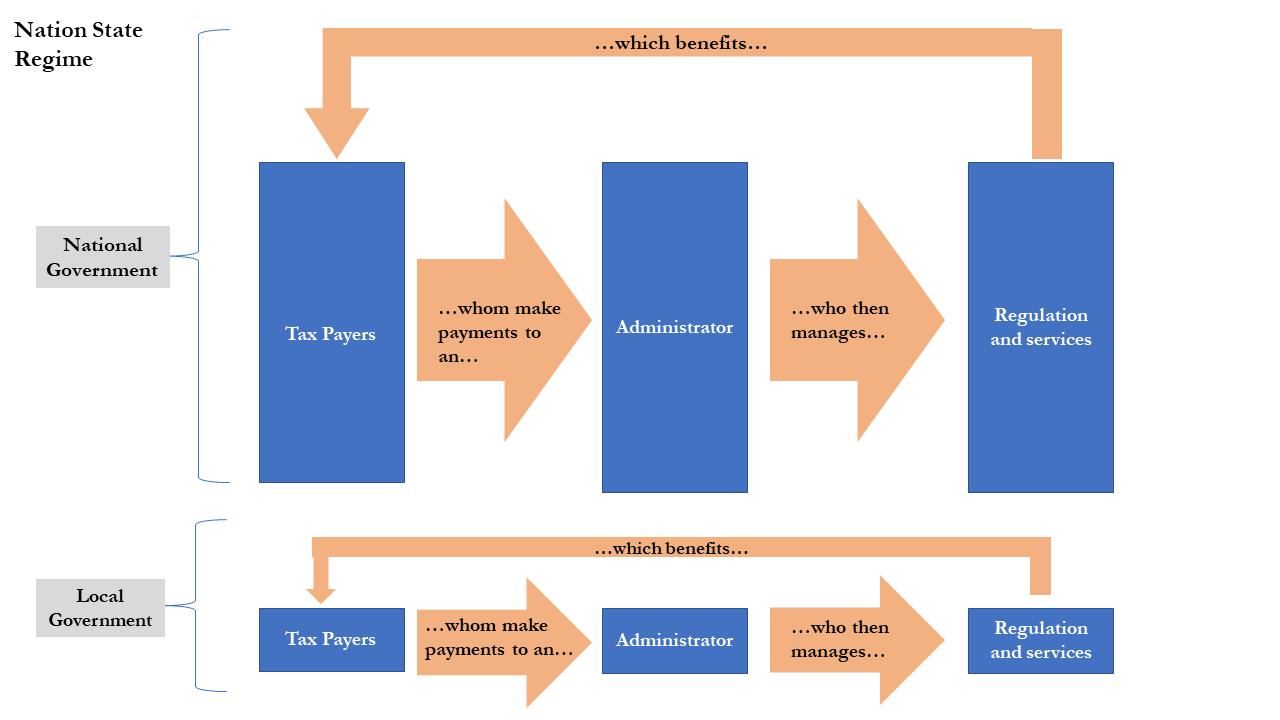
After…

Published : June 24, 2023
How Administrative Regions Would Solve the Problems Caused by the Nation-State Regime

Published : June 24, 2023
Thousands of Laboratories
In a world organized by Administrative Regions, the number of administrative bodies would grow from approximately two hundred (the number of nation-states) to thousands. More administrative bodies (ARs) would ultimately contribute to more government experimentation and differences in approach to public services. More opportunities for innovation will result in better public policy and more efficient state services.
Published : June 24, 2023
Cities are Organic Communities Whereas Nation-states are Synthetic
People have a natural affinity towards cities. Whether it be an apartment or house that one lives in, the school of their children, a group of friends that live close, a hub for employment; community forms organically in cities. Contrast this with the nation-state where racial-ethnic and national “community” is synthetically created by state propaganda, education systems, sporting events, enterprising politicians, and other methods. An organically grown community has stronger bonds than a synthetic one; shared experiences lead to empathy and better collective decision making.
Published : June 24, 2023
Cities Are the Destination
As of the writing of this text, approximately 55% of the world’s population live in cities, and that number is expected to grow to at least 67% in the coming decades. Cities are the epicenter of human civilization and administration of the people should be aligned.
Sources: Urbanization and Cities| https://unhabitat.org/sites/default/files/2020/10/chapter_1_urbanization_and_cities.pdf
Cloud State
Published : June 24, 2023
Imagine the Cloud State (Consolidated PSP)
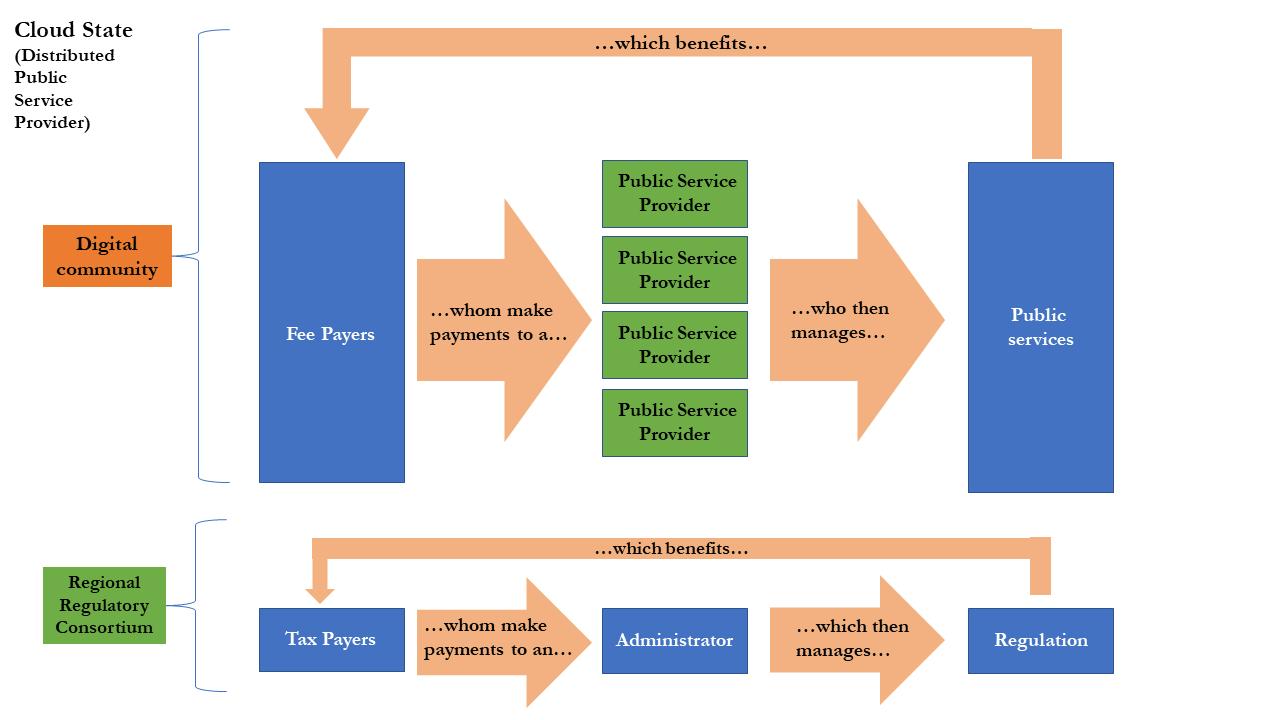
The cloud state model replaces services provided by the government with Public Service Providers (PSP), not a local government (Administrative Region). Instead of elected representatives administering public services funded by taxes, a fee is paid directly to a Public Service Provider. Note that the regulatory function of the government is separated from the public services function.
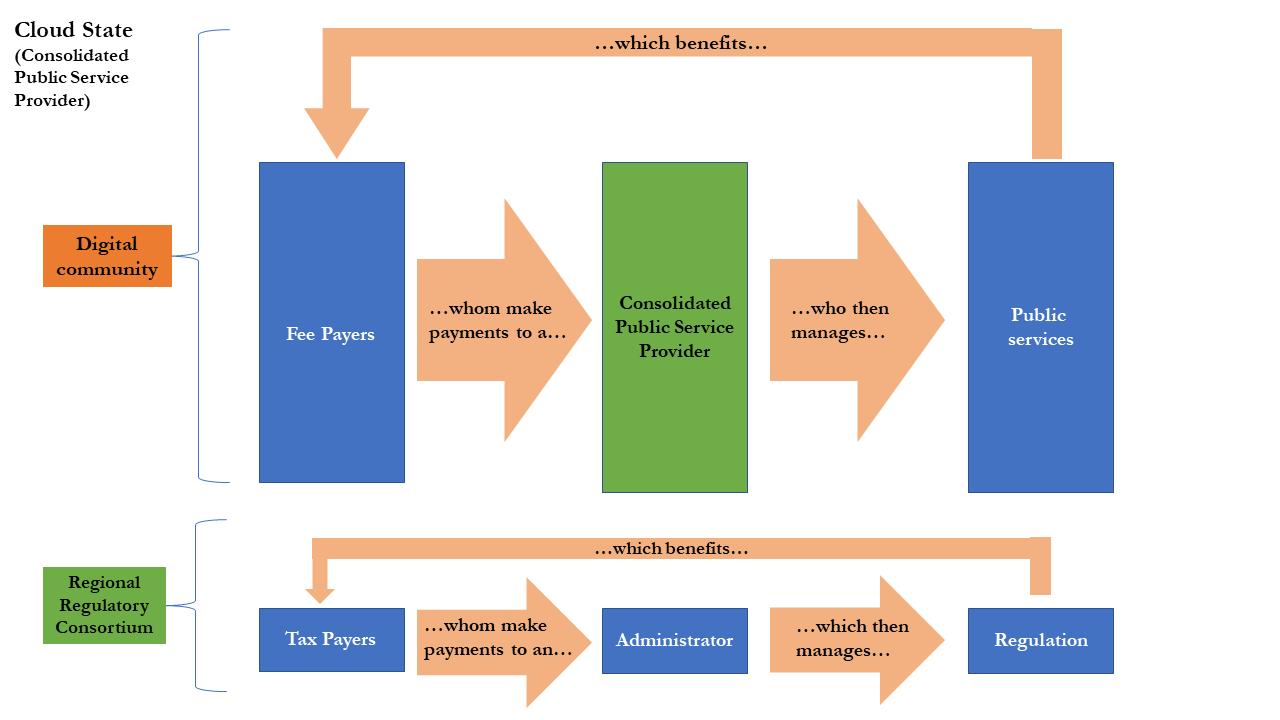
In the cloud state, the body of elected officials acting as middlemen is eliminated. As an example, State-X, a hypothetical public service provider, provides a package of services including sanitation, pension management, healthcare services, legal services, education, etc. The standard charge for these services is $1,000 US a month, with a variety of options and packages to choose from. State-X is in competition with PubServ-4U, another hypothetical public service provider, which would offer a similar variety of services at $975 US a month.

It should be noted that Public Service Providers would be regulated (by a regional regulatory consortium) just as private businesses currently are in most parts of the world. Services could be offered at sliding pricing tiers dependent on a customer’s income level, wealth level, or combination of factors. A sliding scale fee system helps manage the absence of a public social safety net, where providers would be required to subsidize lower income customer fees with higher income customer fees as per the Regional Regulatory Consortium. Additionally, this helps address regressive tax effects present in certain nations under the nation-state regime.
Published : June 24, 2023
Cloud State (Distributed PSP)
A variant of this structure is the Cloud State with distributed Public Service Providers. This enables PSPs to specialize in one service offering vs. a package of public services. In this model, PSPs focus on providing one type of service (e.g. retirement planning) vs. a basket of services. This would benefit consumers as the PSP would specialize in the public service vs. a basket of services.
Published : June 24, 2023
Benefits of the Cloud State
The benefits of the cloud state model include:
- Lower Costs. Opening services to a variety of providers (currently monopolized by the government) will drive down costs for everyone. Nation-state governments have limited cost control accountability, which results in governments issuing debt to fund services, which results in higher taxes and/or tax money being spent on inefficient operations. When services are run by the public sector, cost is not a priority. Profit, sought by investors, enforces disciplined spending in the private sector. Additionally, there are untapped revenue sources that public sector services do not take advantage of, due to the fact that optimizing cost is not enforced. If a business does not reduce costs, investors will eventually stop providing investment/funding. This market-based enforcement mechanism does not exist in the public sector today. Elected representatives are supposed to ensure efficient use of public funds, but when the resource pools are so vast, there is limited accountability of cost.[1]
- Better Services. In the current service model, nation-state governments have a monopoly on multiple public services. Monopolies lead to a lack of innovation as the force of competition cannot be a natural check and balance. Allowing multiple providers to provide public services will be a catalyst for innovation as competition will be present. When an entity has a motivation to increase its user base, it must constantly be attuned to the satisfaction of its customers.
- More Accountability. Citizens of the Nation-state regime cannot change to whom their tax bill goes, it is simply one large government pot. When citizens are able to choose who provides their public services, a check on quality is automatically built in. Accountability will be inherent, it is currently absent.
- Innovation of Hybrid Entities. The fight of government vs. privatization does not have to be so stark, hybrid entities can exist and flourish. Hybrid entities are organizations that can blend aspects of both profit and nonprofit organizations. Hybrid’s can also be thought of as private enterprise, treating “mission” equal to or greater than “profit”. Mission-based enterprise can be utilized to supply public services while generating social good.
- The Removal of Politics from Public Services. Political beliefs should be removed from public services. The irrational and theological aspects of political beliefs clog the effective delivery of public services.
- Freedom to choose with whom your resources are shared. The cloud state allows citizens to have far more influence on whom they are sharing their resources with. In the nation-state regime, not only do citizens share their resources with mostly people they do not know, but with people who have drastically different value systems.
- Geographic Independence. The cloud state provides much more geographic independence, in that a citizens state can move with them. Contrast the nation-state regime, where moving states is logistically complex and overly burdensome.
Sources: Prime Cuts Summary|https://www.cagw.org/sites/default/files/pdf/PrimeCuts%202015web.pdf
Published : June 24, 2023
Cloud States Today
The cloud state is operating in small pockets of the public sector today. Certain governments outsource specific public functions to private providers. For example, trash or utilities in many nation-state regimes are public/private partnerships, blending operations of both public and private sector entities.
Additionally, there is vast experimentation throughout the tech sector which is developing the metaverse, an evolution of the internet. Many virtual worlds are being created which will soon have the need for governance and authority, and perhaps a gateway to expanding the cloud state.
Sources: Inside Federal Outsourcing|https://cdn.govexec.com/media/gbc/docs/gbc_government_outsourcing_report.pdf
Equity States
Published : June 24, 2023
Imagine the Equity State
Imagine the equity state, where taxes are not paid, but investments are made. The equity state is a form of government that revolves around ownership of public assets, not tax burdens. The Equity State is not a wave of a magic wand to rid the world of taxes, but is a different approach to ownership of public services.

The equity state grants explicit ownership of public assets to citizens, as opposed to general funding for the common good. The investment/ownership model would vastly improve the perception and performance of government.
Published : June 24, 2023
The Allure of Investing
Simply put, most love investing and hate paying taxes. People invest in something they want to be a part of, as they envision a future benefit (e.g. more money). Taxes do not have the same psychological allure as an investment; taxes lack excitement. So much in fact, that there are entire industries built around reducing one’s tax “bill.” So let us ask, why does everyone try to avoid paying for public services from which they benefit? Whether it is to secure the assets of the rich or help the poor to eat, public services funded by taxes accrue wealth for everyone, just as investing in a retirement fund. So why do we hate paying taxes even though the services produced from these funds benefit us? There are a variety of answers, but one of the primary reasons is that there is no explicit record of ownership and benefit. Stated differently, taxes have a “marketing problem.” Human beings need tangible proof of what is theirs. Under the Nation-state regime, citizens do not “own” a portion of the military which ensures their assets are safe. Nobody explicitly owns a portion of the roads on which their vehicles commute.
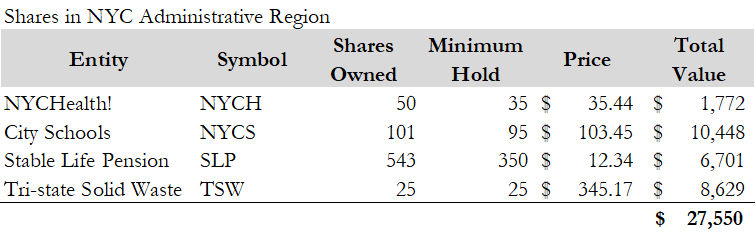
It is human nature to favor one’s personal belongings and wealth over the public pot of resources. We are selfish creatures and need an artifact to remind us of what is ours. So how do we solve this dilemma? Ownership for everyone; an explicit record of ownership for all public assets. An illustrative example is below:
Published : June 24, 2023
How the Equity State Could Work
All citizens of an Administrative Region would be allocated a number of shares of each Public Service Provider. Each citizen would be required to hold a minimum number of shares with the excess being available to trade or sell. As an example, the Chen family owns a single-family residence within The NYC Administrative Region (the NYC City State). The Chen’s Ownership of the land and house entitles them to 50 shares of NYCHealth!, a PSP which provides healthcare services to people within the NYC-AR. When NYCHealth! needs to appoint a new CEO, the Chen family votes its 50 shares for approval or non-approval. Any profit NYCHealth! brings in for the quarter is returned to its shareholders in the form of a dividend; all citizen-investors receive a cash payment. If a deficit occurs, additional funding is required, which can either take the form of public debt or additional share issuance.
A direct ownership structure will provide citizen-investors with a vested interest in disciplined spending (as they receive a cash benefit) balanced with quality services that they utilize. Each citizen-investor will hold a portfolio of assets, just as they do in their retirement account.
Ownership allocation, meaning how many shares does each person hold, can take a variety of forms. Some Administrative Regions could opt for simple structures like one person one share, others could construct a hierarchy of share classes, each with different benefits, restrictions and contribution/distribution rules.
The Consortium Model
Published : December 10, 2023
Most services of government can be replaced and run more efficiently with the proposed decentralized models. There are some functions, however, that benefit from some level of centralization and thus a governing body via consortium is required.
The Regional Regulatory Consortium (RRC)
The RRC is a governing body that would manage regulation of commerce by region. Examples of current government functions which could be replaced by RRCs include regulatory agencies (e.g. FDA, SEC, EPA). The mandate of a RRC will be to ensure that commerce is conducted ethically and without abuse from bad actors. This includes consumer safety, environment sustainability, licensing, and other functions. It should be noted that many of these regulatory functions can be funded by charging industry user fees, and thus funding from a centralized general tax pool is not crucial.
Defense
Even in a target state model where nation-states cease to exist, there will still be bad actors that organize armed groups of people attempting to amass wealth and power. Thus, a defense force is required to maintain order. A professional military which could represent people across a region or the globe would be established to thwart armed aggression. Each Administrative Region would help fund the defense consortium either through a fee collected from its citizens or a group of reserve troops ready to serve in the event of an armed aggressor.
FDA at a Glance|https://www.fda.gov/about-fda/fda-basics/fact-sheet-fda-glance
https://www.economist.com/briefing/2023/08/31/how-cynical-leaders-are-whipping-up-nationalism-to-win-and-abuse-power